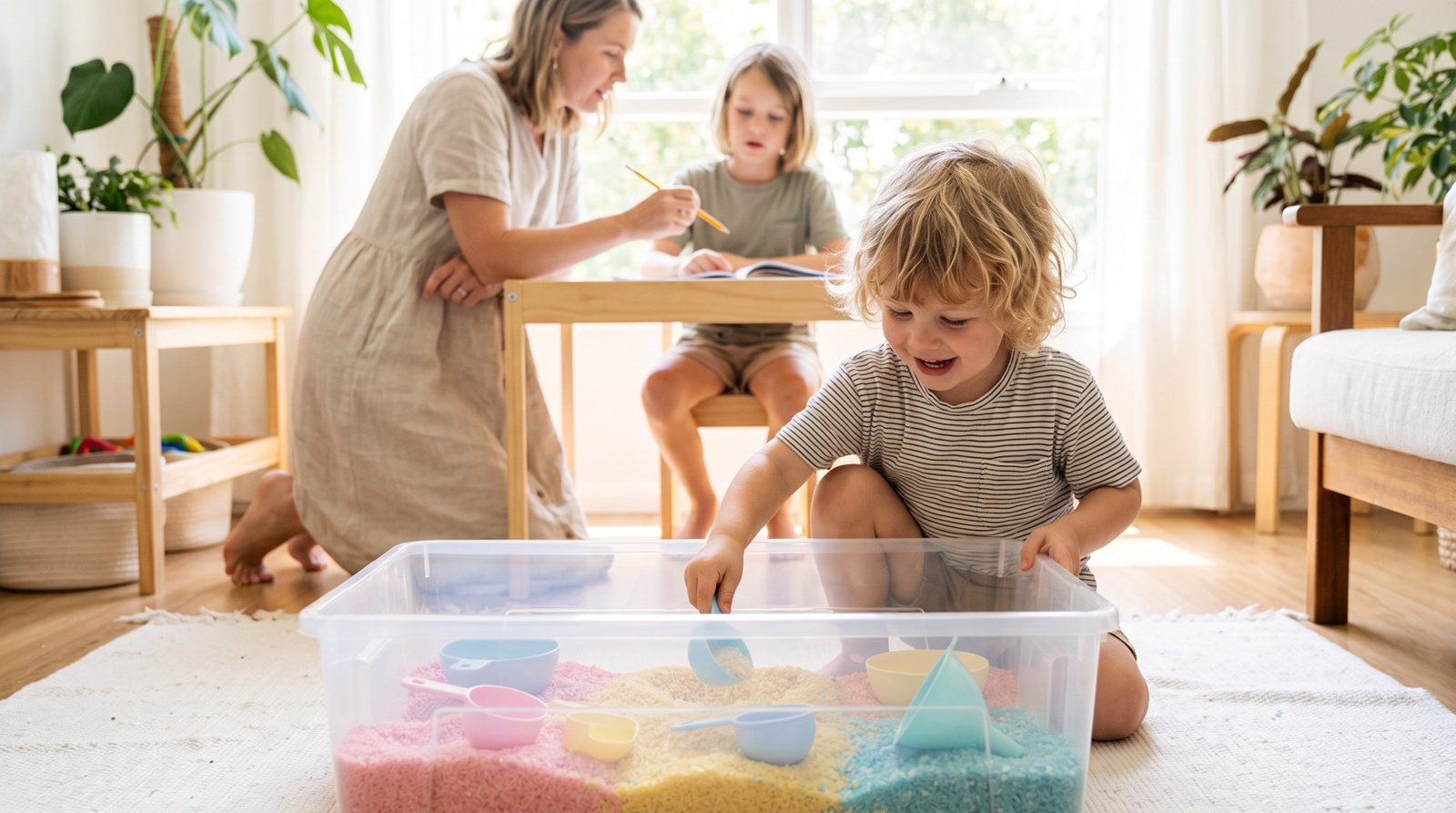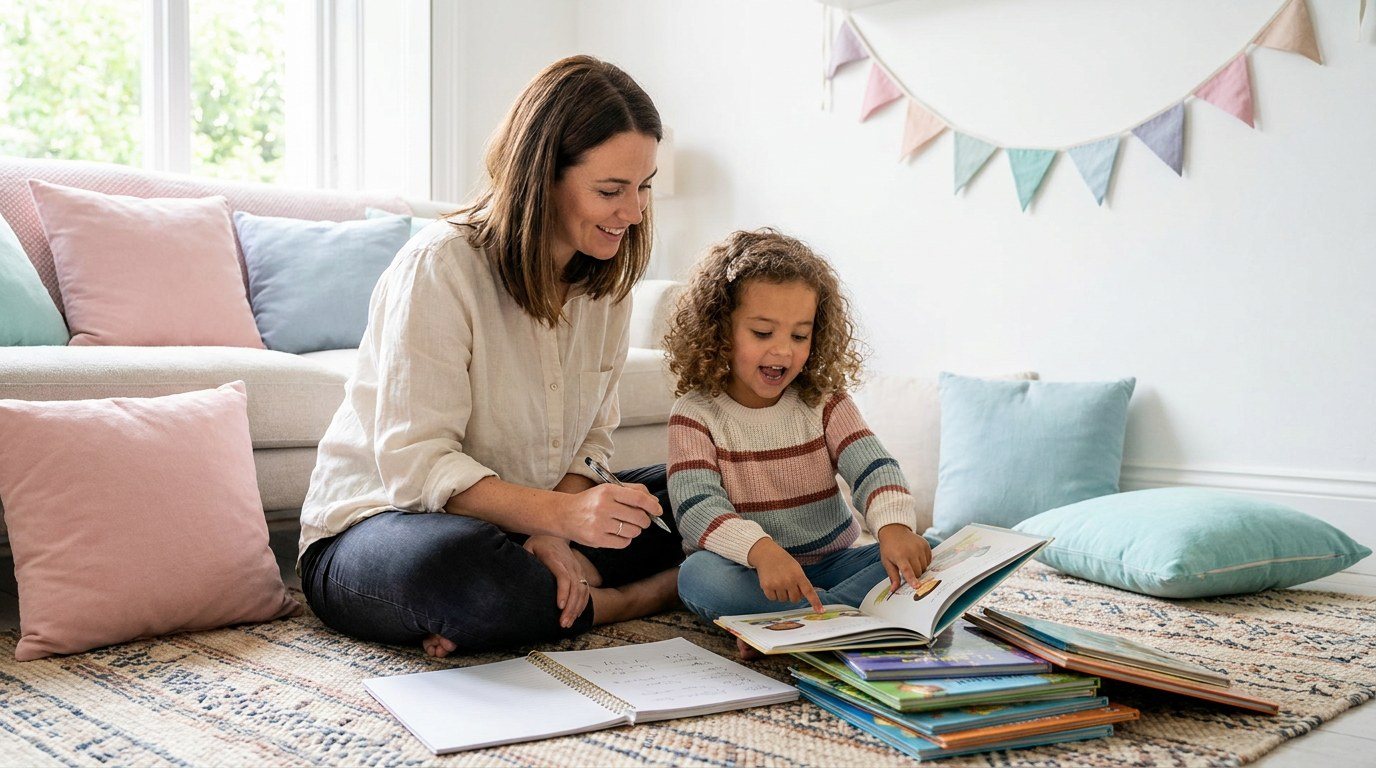

If you are homeschooling multiple ages, you probably know the feeling. The kindergartner wants help sounding out a word, the fifth grader is stuck on long division, and the toddler has just discovered the glitter. You are one parent with three (or four, or six) very different learners.
Here is the good news: you do not need to run a separate school day for every child. The families who make this feel calm usually do one simple thing. They teach together whenever they can, and they split up only when a skill truly needs it.
This guide walks you through exactly how to do that, with real picture books, sample schedules, and practical ideas for little ones, independent work, and everything in between.
Quick answer: The easiest way to handle homeschooling multiple ages is to (1) teach shared subjects like read-alouds, science, history, and art together, (2) layer each lesson with an easy, medium, and stretch follow-up for each age, (3) give each child a short one-on-one block for math and reading, (4) prepare independent work and toddler activities ahead of time, and (5) follow a predictable weekly rhythm so everyone knows what comes next.
Why teaching multiple ages together actually works
Mixed-age learning has real advantages for a family:
- Younger kids rise to the conversation. A six-year-old listening to a discussion about why owls hunt at night picks up vocabulary and ideas well beyond a "grade level."
- Older kids learn by explaining. When your eighth grader helps a little sibling, they have to understand the idea well enough to put it in simple words.
- You plan once, not three times. One book, one theme, one shared activity, with small tweaks for each child.
Mixed-age learning does not mean everyone does the same worksheet. It means everyone gathers around the same idea and goes as deep as they are ready to go.
The three-ring approach: Littles, Middles and Bigs
Think of your homeschool as a circus with three rings and one big tent. The tent is the shared topic. The rings are the levels, each doing their own act under it.
At Quaintly Curious we use three levels:
| Level | Grades | Focused lesson time per day | What they need most |
|---|---|---|---|
| Littles | K-3 | 30-45 minutes | Short lessons, hands-on play, lots of read-aloud, phonics and early math practice |
| Middles | 4-6 | 60-90 minutes | Growing independence, narration and short writing, longer projects, chapter books |
| Bigs | 7-8 | 90-120 minutes | Research, longer writing, self-managed checklists, leading and presenting |
These are guidelines, not rules. Match the work to the child, not the grade on paper.
Step 1: Choose what you will teach together
The secret to homeschooling multiple children without exhaustion is to sort your subjects into two piles.
Teach together (family style):
- Read-alouds and literature
- Science and nature study
- History and geography
- Art, music, and poetry
- Picture books (yes, even for your Bigs)
- Projects, field trips, and cooking
Teach separately (skill subjects):
- Math
- Phonics and early reading
- Spelling and handwriting
- Writing instruction at very different levels
Most families find that two-thirds or more of their week can be shared. That is a huge relief when you are teaching multiple grades at home.
Step 2: Layer every shared lesson by age
Layering is how one lesson serves a five-year-old and a thirteen-year-old at the same time. You start with a shared "spark," then give each level a follow-up that fits.
Here is what that looks like with Owl Moon by Jane Yolen, a quiet, beautiful winter picture book about a child and father going owling.
- Shared spark (everyone): Read Owl Moon aloud. Turn off the lights and listen to a recording of a great horned owl call. Talk about how it would feel to stay quiet in the snowy woods.
- Littles: Draw the owl and the moon, then dictate one sentence about it. Practice the "oo" sound in moon, hoot, and woods.
- Middles: Write a short paragraph from the owl's point of view. Look up three facts about great horned owls and add them to a nature notebook.
- Bigs: Study how Jane Yolen uses sensory language and similes, then write a poem about a nighttime walk using at least three similes. Research how owls hunt silently.
- Back together: Everyone shares what they made. Littles hold up drawings, Middles read their paragraphs, Bigs perform their poems.
The book is the same. The thinking is matched to each child. That is the heart of multi-age homeschooling.
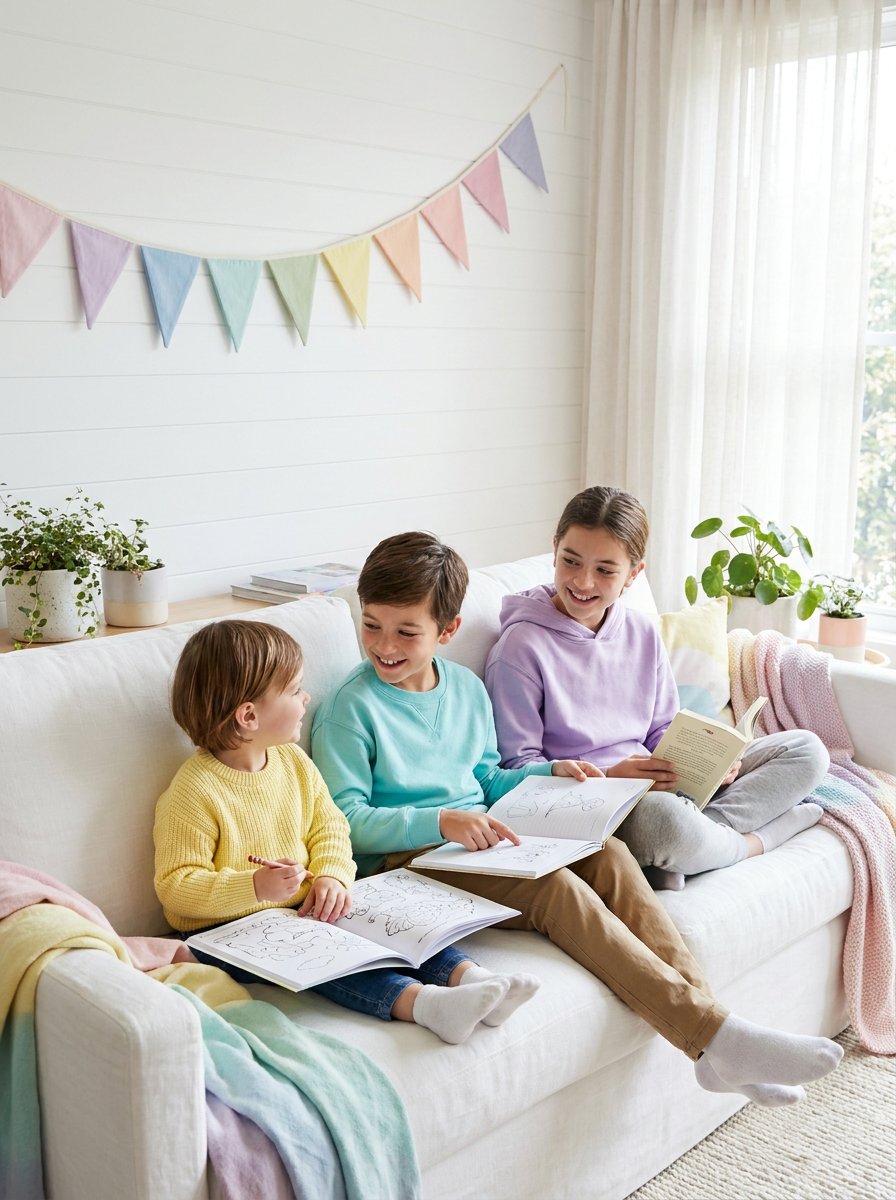
If you want a ready-made way to do this, our free Popcorn Planner "pops" any picture book into a bite-sized, five-day week of learning for Littles, Middles and Bigs, and it includes a fully worked week for Blueberries for Sal by Robert McCloskey. It is a gentle way to try layering before you commit to anything bigger.
For more on building whole weeks around books, see our guide to literature-based homeschooling for ideas on turning one great book into a whole week.
Step 3: Build a weekly rhythm everyone can follow
When you are teaching several ages, predictability is your best friend. Kids settle faster when they know what kind of day it is.
We use a simple five-day rhythm for every season:
- Monday: Read & Wonder. Introduce the week's book or topic. Read aloud, look at pictures, and write down big questions.
- Tuesday: Words & Worlds. Vocabulary, writing, geography, and history connected to the book.
- Wednesday: Nature & Number. Science, nature study, and math connections (counting snowflakes for Littles, measuring and graphing for Bigs).
- Thursday: Make & Do. Art, crafts, experiments, building, cooking.
- Friday: Showtime. Each child shares or presents something they made that week.
Showtime is the part kids love most. A Little might hold up a paper mitten full of felt animals after reading The Mitten by Jan Brett, while a Big explains how Wilson Bentley photographed snowflakes after reading Snowflake Bentley by Jacqueline Briggs Martin. Everyone gets an audience, and everyone gets a turn in the spotlight.
If you want to dig into time blocks and planning, our homeschool schedule post has sample daily and weekly schedules by level.
Step 4: Plan a daily flow for multiple kids
A weekly rhythm tells you what. A daily flow tells you when. Here is a sample flow that works for many families teaching several kids. Adjust the times to your own household.
| Time | Littles (K-3) | Middles (4-6) | Bigs (7-8) |
|---|---|---|---|
| 9:00 | Together: morning basket, read-aloud, shared lesson | Together | Together |
| 9:45 | One-on-one: phonics and math with you | Independent work checklist | Independent reading or research |
| 10:15 | Busy bin or free play | One-on-one: math and writing check-in | Independent math |
| 10:45 | Snack and outdoor play | Snack and outdoor play | One-on-one: writing conference |
| 11:15 | Done with lessons, play | Finish project work | Finish project work |
| Afternoon | Quiet time, audiobooks | Free reading, hobbies | Long-term project, reading |
Notice the pattern: start together, then rotate one-on-one blocks while the others work alone. Littles finish first, which is perfect.
A cheerful morning basket is a lovely way to gather everyone at the start of the day before you split off.
Step 5: Teach independent work on purpose
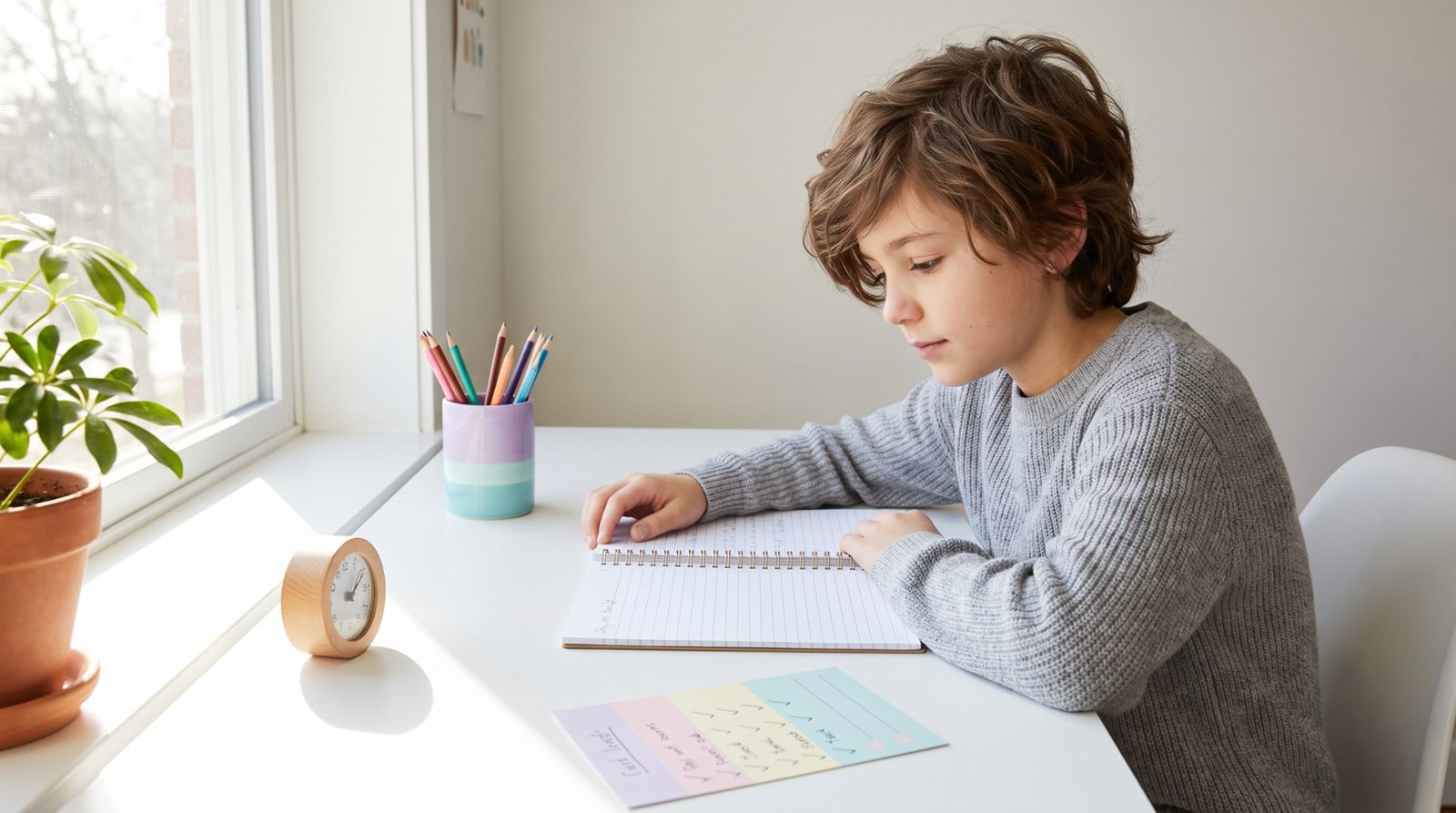
Independent work is what makes your one-on-one time possible. If the fifth grader cannot work alone for twenty minutes, you cannot sit with the first grader for phonics.
Independence is a skill, and like any skill, you teach it in small steps:
- Start small. Ten minutes of solo work is a win for a seven-year-old.
- Use a visual checklist. Pictures for Littles, short lists for Middles, weekly planners for Bigs.
- Choose work they already know how to do. Independent time is for practice, not brand-new concepts.
- Set up a "help menu." What to do when stuck: reread the directions, try the next problem, then check with you at the next break.
- Check in and celebrate. Look over the work together so it feels valued.
We go much deeper on this, with specific ideas for each level, in our guide to homeschool independent work.
Independent work does not have to be a worksheet. Audiobooks, copywork, math games, nature journaling, and puzzles all count (puzzles are a favorite).
Step 6: Make a plan for the little ones
Toddlers and preschoolers are often the hardest part of a multi-age homeschool. They want to be included, and they want your attention right now.
The trick is to plan for them as carefully as you plan for the older kids:
- Invite them in. Give them crayons, play dough, or a wooden puzzle at the table during read-alouds. Being near the action matters to them.
- Rotate busy bins. A small set of special boxes that only come out during lesson time stays interesting much longer.
- Use nap and quiet time wisely. Save your most focused one-on-one teaching with older kids for those windows.
- Enlist older siblings. A Big reading The Very Hungry Caterpillar by Eric Carle to a toddler counts as reading practice for one and a lovely moment for both.
- Keep lessons short. A twenty-minute block is easier to protect than an hour.
For a full list of busy bin ideas, quiet activities, and timing tips, read our guide on how to keep younger kids busy while homeschooling.
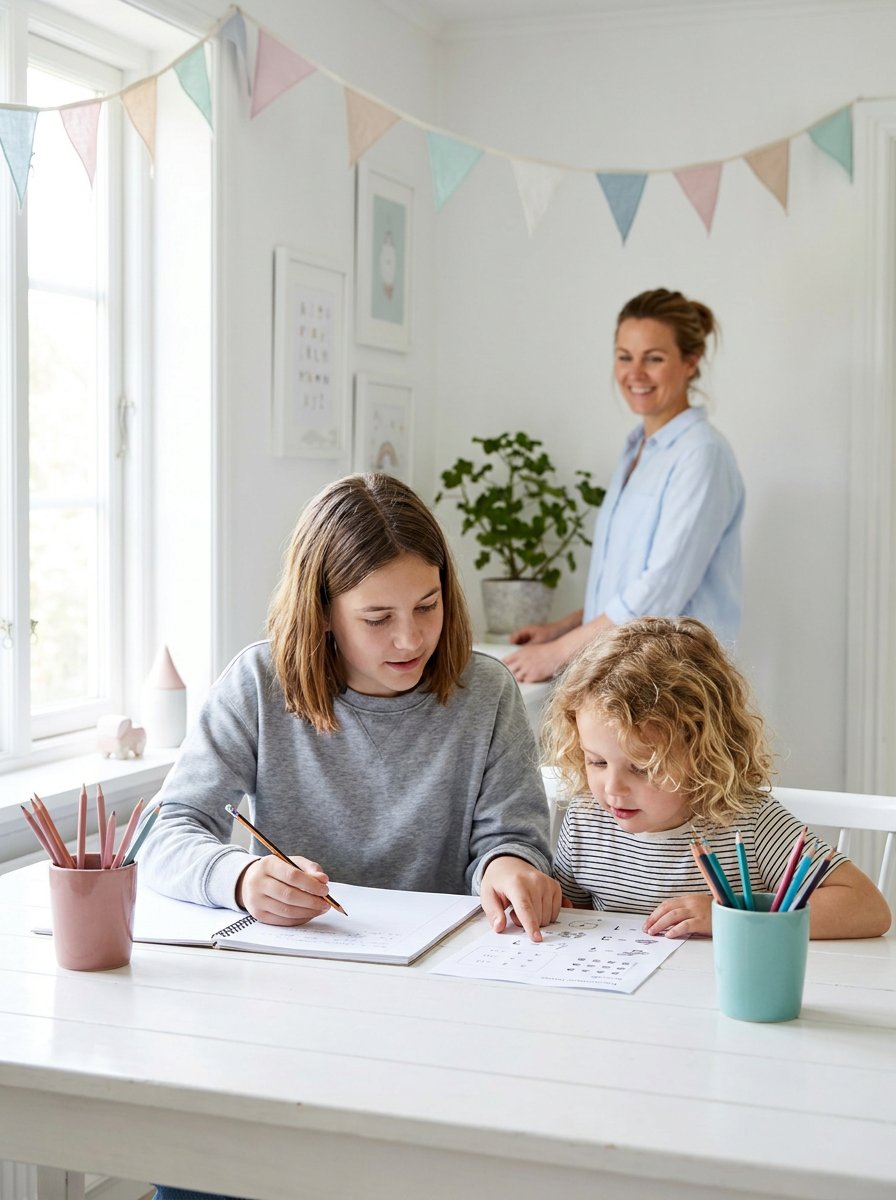
Choosing curriculum for a multi-age homeschool
When you shop for curriculum, ask one question first: "Can my kids share this?"
Approaches that tend to work well for families homeschooling multiple children include:
- Literature-based learning. Great books work for many ages at once. Charlotte's Web by E.B. White can be a gentle read-aloud for a first grader and a character study for a seventh grader.
- Unit studies. One theme (snow, oceans, the night sky) ties together science, reading, writing, and art. Our guide to homeschool unit studies explains how to build one.
For math and early reading, most families use leveled programs so each child works at the right step. That is the one place where a separate curriculum per child really pays off.
Common challenges (and what helps)
"My oldest is bored and my youngest is lost." This usually means the shared lesson is pitched to the middle. Keep the spark short and let the follow-up do the differentiating. Give your oldest a real stretch task, like teaching part of the lesson.
"I spend all day going back and forth." Try clustering. Instead of jumping between kids every five minutes, give each child one protected block with you, and treat the rest as independent time.
"Someone always needs me during one-on-one time." Use a visual signal, like a small stuffed animal or a sign on the table, that means "I am teaching right now, use your help menu." It takes a few weeks to stick, so be patient.
"I am worried we are not doing enough." Homeschool requirements vary by state, so check your state's department of education or HSLDA's state law page to understand what applies to you. Beyond that, remember that focused learning at home is efficient. A short, engaged lesson often beats a long, distracted one.
A sample week for multiple ages: winter edition
Here is a simple week built around winter picture books to show how it all comes together.
- Monday, Read & Wonder: Read The Snowy Day by Ezra Jack Keats. Littles act out making snow angels. Middles and Bigs list questions about snow (Why is it white? Why does it squeak?).
- Tuesday, Words & Worlds: Build a winter word wall together. Littles trace snow and cold. Middles write a cozy winter paragraph. Bigs compare how two authors describe snow.
- Wednesday, Nature & Number: Catch snowflakes on black paper (or make paper ones). Littles count points (always six). Middles sort snowflake shapes. Bigs read about how ice crystals form on NOAA's SciJinks site.
- Thursday, Make & Do: Everyone cuts paper snowflakes. Bigs try to design one with true six-fold symmetry.
- Friday, Showtime: Hang the snowflakes and let each child present one thing they learned.
Taking care of the ringmaster (that is you)
It is easy to pour everything into the kids and forget the person holding the whole show together. A few things help:
- Lower the bar on perfect days. Some days, a read-aloud on the couch and a walk outside is the whole lesson plan. That still counts.
- Prep the week in one sitting. Pull books, print pages, and fill bins on Sunday so weekday mornings are calmer.
When I think about the happiest learning I have ever seen, I think of my mom's classroom, with kids of all kinds tucked into the reading corner with library books. That mix of ages and curiosity is exactly what a multi-age homeschool can feel like on a good day.
Frequently asked questions about homeschooling multiple ages
How do you homeschool multiple kids at different grade levels?
Teach shared subjects together and separate only for skill subjects. Read aloud, science, history, art, and nature study work well as a group, with each child doing an age-appropriate follow-up. Math, phonics, and writing usually need one-on-one time, so rotate short focused blocks while the other kids do independent work or quiet bins.
Can you use one curriculum for multiple ages?
Yes, for many subjects. A literature-based or unit-study approach lets the whole family share one book or theme while each child works at their own level. Most families still use separate, leveled materials for math and early reading, because those skills build step by step and need to match where each child actually is.
How many hours a day should I homeschool multiple children?
It depends on ages and your state's requirements, but focused work at home takes far less time than a school day. Many families find younger children need about 30 to 45 minutes of structured lessons, middle grades 60 to 90 minutes, and older kids 90 to 120 minutes, plus reading, play, and projects.
What do I do with a toddler while homeschooling older kids?
Plan for the toddler instead of hoping they nap. Keep a few rotating busy bins, invite them to the table with crayons or play dough during read-alouds, schedule focused lessons during naps or quiet time, and let an older sibling read to them as part of the day. Short lessons help a lot.
Is homeschooling multiple ages harder than homeschooling one child?
It is different rather than simply harder. You juggle more needs, but you also gain shared lessons, built-in discussion partners, and older kids who learn by teaching younger ones. Many parents find that once they stop running separate school days for each child, teaching several ages becomes more efficient and more fun.
The whole troupe, one big tent
Homeschooling multiple ages is not about doing three times the work. It is about gathering everyone under one big tent, then letting each child perform their own act. Teach together first, layer by age, protect short one-on-one blocks, and plan for independent work and little ones before you need them.
Start with one book and one week. You may be surprised how much your kids learn from each other.
Step right up: Want every week planned for all three ages? The Big Top is our seasonal homeschool membership, with five-day lesson plans for Littles, Middles and Bigs, weekly puzzles, games, a month-end project, and Showtime every Friday with the Troupe. One flat price of $33/month covers the whole family, and you can cancel anytime. Not ready yet? Grab the free Popcorn Planner and turn any picture book into a five-day week for every age.