One of the first questions new homeschool parents ask is, "What does a homeschool day actually look like?" It is a fair question. Without a school bell, a homeschool schedule can feel like a blank page.
Here is the short version: a good homeschool schedule is shorter than you expect, built on routines rather than rigid times, and shaped around the ages in your house. Below you will find sample daily schedules for Littles, Middles and Bigs, a simple weekly rhythm, and ideas for juggling more than one child.
Quick answer: A simple homeschool schedule has four parts: a shared start (like a morning basket), focused skill time for math and reading, one themed activity for everyone, and free time for play, reading and the outdoors. Plan about 30-45 minutes of focused lessons for K-3, 60-90 minutes for grades 4-6 and 90-120 minutes for grades 7-8. Use routine blocks, not strict clock times.
Why a homeschool schedule is shorter than a school day
A school day includes lining up, transitions, waiting for 25 classmates and lots of necessary classroom management. At home, one-on-one teaching moves quickly. That is not a criticism of schools. It is simply a different setting.
So if your kindergartner is "done" by 10:00 a.m., you have not shortchanged anyone. The rest of the day is full of learning too: building, cooking, nature walks, audiobooks and questions at the dinner table.
Routine blocks vs. clock times
There are two main ways to build a homeschool daily schedule:
- Clock-based: "9:00 math, 9:30 reading, 10:00 snack." Clear and structured, but one slow morning can knock the whole day off.
- Routine-based: "After breakfast we do the morning basket, then math, then our project." Same order every day, no clock pressure.
Most families find routine blocks calmer and easier to keep. Kids still know what comes next, which is what makes a schedule feel safe. If you love clocks, try time blocks with 15 minutes of buffer between them.
Sample homeschool schedules by age
These are examples, not rules. Shift them to fit nap times, work schedules and your family's natural energy.
Littles (K-3): about 30-45 minutes of focused lessons
| Block | What it looks like |
|---|---|
| Breakfast and chores | Feed the cat, make beds, get dressed |
| Morning basket (15 min) | A picture book, a short poem, a song |
| Phonics or reading (10-15 min) | One short lesson, then read together |
| Math (10-15 min) | Hands-on counting, games, manipulatives |
| Themed activity (15-20 min) | Today's rhythm activity: a craft, an experiment, a nature walk |
| Lunch and outside play | Long, unhurried, muddy if possible |
| Quiet time | Audiobooks, picture books, puzzles, drawing |
Littles learn through play and short bursts. Stop while they are still enjoying it.
Middles (grades 4-6): about 60-90 minutes of focused lessons
| Block | What it looks like |
|---|---|
| Morning basket (20 min) | Read-aloud chapter, poetry, a picture study |
| Math (25-30 min) | Lesson plus a few practice problems |
| Language arts (20-25 min) | Spelling, grammar or a short writing piece |
| Themed activity (20-30 min) | Science, history or geography tied to the week's book |
| Independent reading (20-30 min) | A novel of their choice |
| Afternoon | Projects, sports, clubs, outdoor time |
Middles are ready for a little homeschool independent work, such as a checklist they finish on their own while you work with a younger sibling.
Bigs (grades 7-8): about 90-120 minutes of focused lessons
| Block | What it looks like |
|---|---|
| Morning basket (20 min) | Shared read-aloud, current events discussion, poetry |
| Math (40-45 min) | Pre-algebra or algebra lesson and practice |
| Writing and literature (30 min) | Essays, literary analysis, a longer novel |
| Science or history (30 min) | Research, labs, reading, note-taking |
| Independent project time | A passion project, a presentation for Friday |
| Afternoon | Jobs, volunteering, sports, music, friends |
Bigs can own much of their week. Give them a weekly checklist and a short Monday meeting to plan it together.
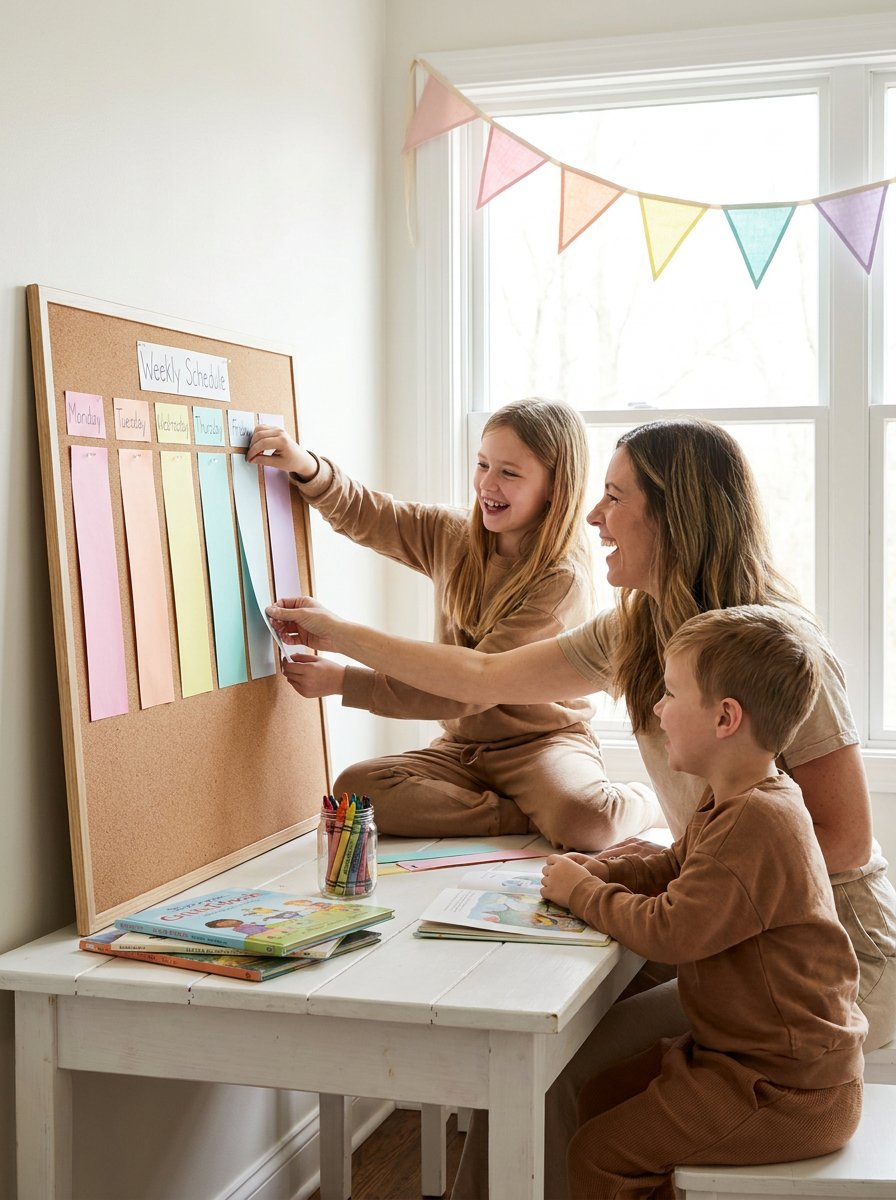
A sample weekly homeschool schedule
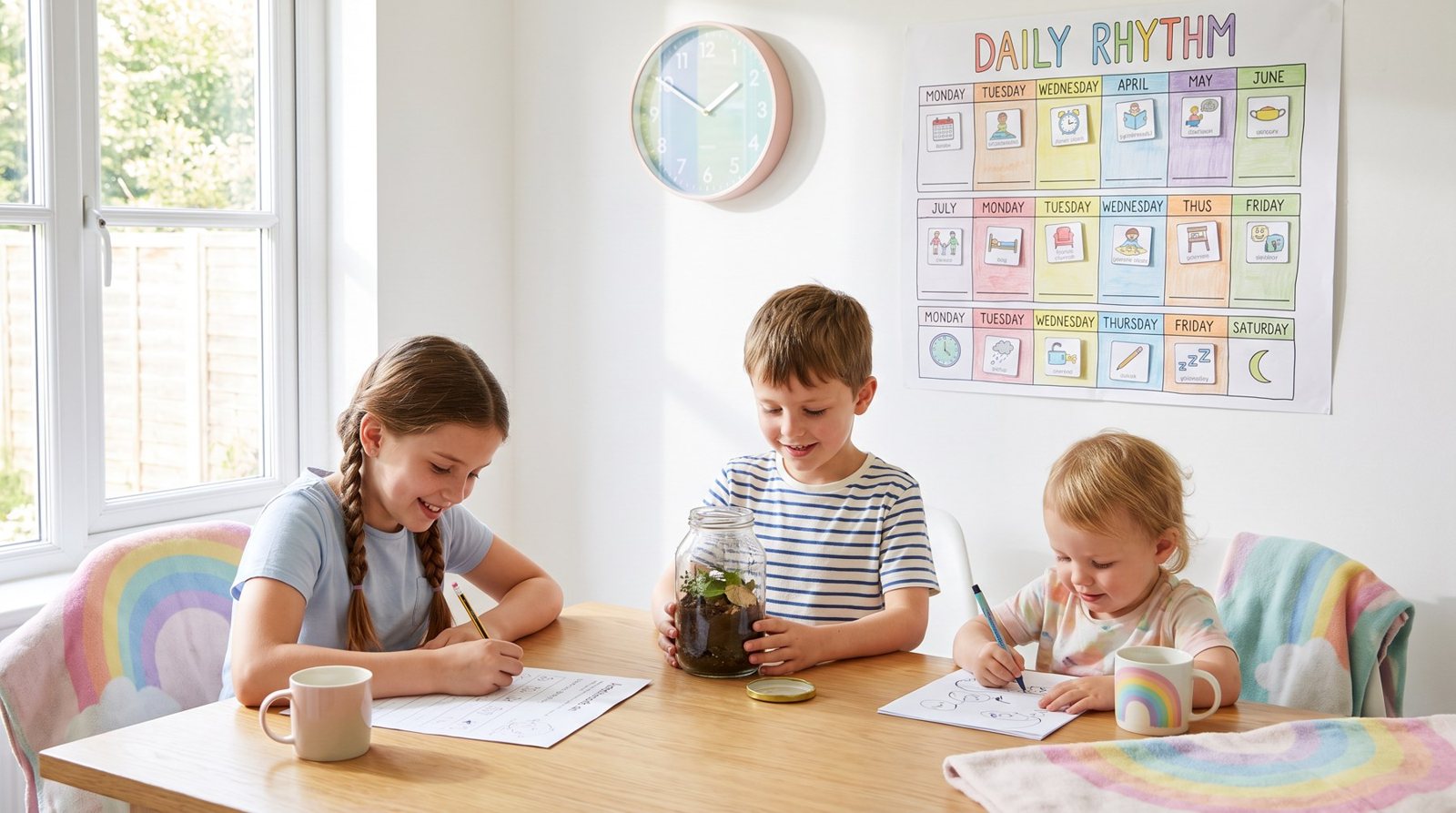
A weekly rhythm gives each day its own flavor, so you are not reinventing the week every Sunday. Here is our signature five-day rhythm, which works across all three levels:
- Monday, Read & Wonder: Read the week's anchor picture book and make a list of questions.
- Tuesday, Words & Worlds: Vocabulary, writing, maps and history connections.
- Wednesday, Nature & Number: Science and math tied to the theme, ideally outdoors.
- Thursday, Make & Do: Crafts, building, cooking, drama.
- Friday, Showtime: Kids share or present what they made that week.
For example, with The Mitten by Jan Brett, Littles might retell the story with stick puppets on Thursday, while Bigs research how real animals survive winter on Wednesday. Everyone takes a bow on Friday.
Math and reading lessons happen every day alongside the rhythm. The themed activity simply rotates.
Want this rhythm on paper? The Popcorn Planner is a free printable that turns any picture book into a five-day week for Littles, Middles and Bigs, with a worked Blueberries for Sal example to copy.
Scheduling multiple ages without chaos
Teaching several kids at once is a juggling act, but a few habits help the whole troupe run smoothly.
Start together
A shared morning basket brings everyone to the same table before you split up. It covers poetry, read-alouds and art in one cozy block. See our guide to the homeschool morning basket to set one up.
Stagger the skill work
While you teach math to your Little, your Middle does independent reading and your Big works through a checklist. Then rotate. A simple "with Mom / on my own" chart makes it clear who is doing what.
Plan for the youngest
Toddlers and preschoolers need something too. A special basket of busy activities that only comes out during lessons can buy you 20 precious minutes. Our guide on how to keep younger kids busy while homeschooling is full of ideas.
Share the theme
When everyone studies the same book, you teach one lesson at three depths instead of three separate lessons. That is the heart of good homeschool lesson planning.
Tips to make your routine stick
- Anchor it to daily events. Breakfast, lunch and quiet time are natural transitions.
- Put the hard stuff early. Math and reading go first while focus is fresh.
- Leave white space. Not every hour needs a plan.
- Use visual cues. Picture charts help Littles; checklists help Bigs.
- Review after two weeks. Change what is not working. A schedule is a tool, not a rulebook.
- Know your state's requirements. Some states set days or hours. Check HSLDA's state law page or your state department of education.
Frequently asked questions
How many hours a day should you homeschool?
Far fewer than a school day. Many families find that kids in K-3 need about 30 to 45 minutes of focused lessons, grades 4-6 about 60 to 90 minutes, and grades 7-8 about 90 to 120 minutes, plus reading, play and outdoor time. One-on-one teaching is efficient, so short sessions go a long way. Check your state's rules in case it sets required hours.
What time should a homeschool day start?
Whenever works for your family. Some start at 8:30 after breakfast, others at 10:00 after chores and a walk. Many kids focus best in the morning, so it helps to put math and reading early. Consistency matters more than the exact start time, because a predictable rhythm cuts down on daily negotiation.
Should a homeschool schedule use set times or routines?
Most families find routines easier than strict times. A routine says what comes next (breakfast, morning basket, math, then a project) instead of when. That way a slow morning or a doctor visit does not wreck the day. If your kids thrive on clocks, try loose time blocks with buffer time between them.
Do homeschoolers have to school five days a week?
Not necessarily. Some families do a four-day week with a field trip or co-op day, and others school year-round with more breaks. Rules about days or hours vary by state, so check your state's requirements on HSLDA's legal page or your state department of education, then pick the rhythm that suits your family.
Find the rhythm that fits your family
The best homeschool schedule is the one your family can actually live with. Keep focused lessons short, lean on routines, give each weekday a flavor and leave plenty of room for play. Then adjust as your kids grow. What works this fall may look different by spring, and that is perfectly fine.
Step right up: Grab The Popcorn Planner, our free printable that pops any picture book into a five-day week for Littles, Middles and Bigs. Print it, pick a book and your first week is ready by tonight.