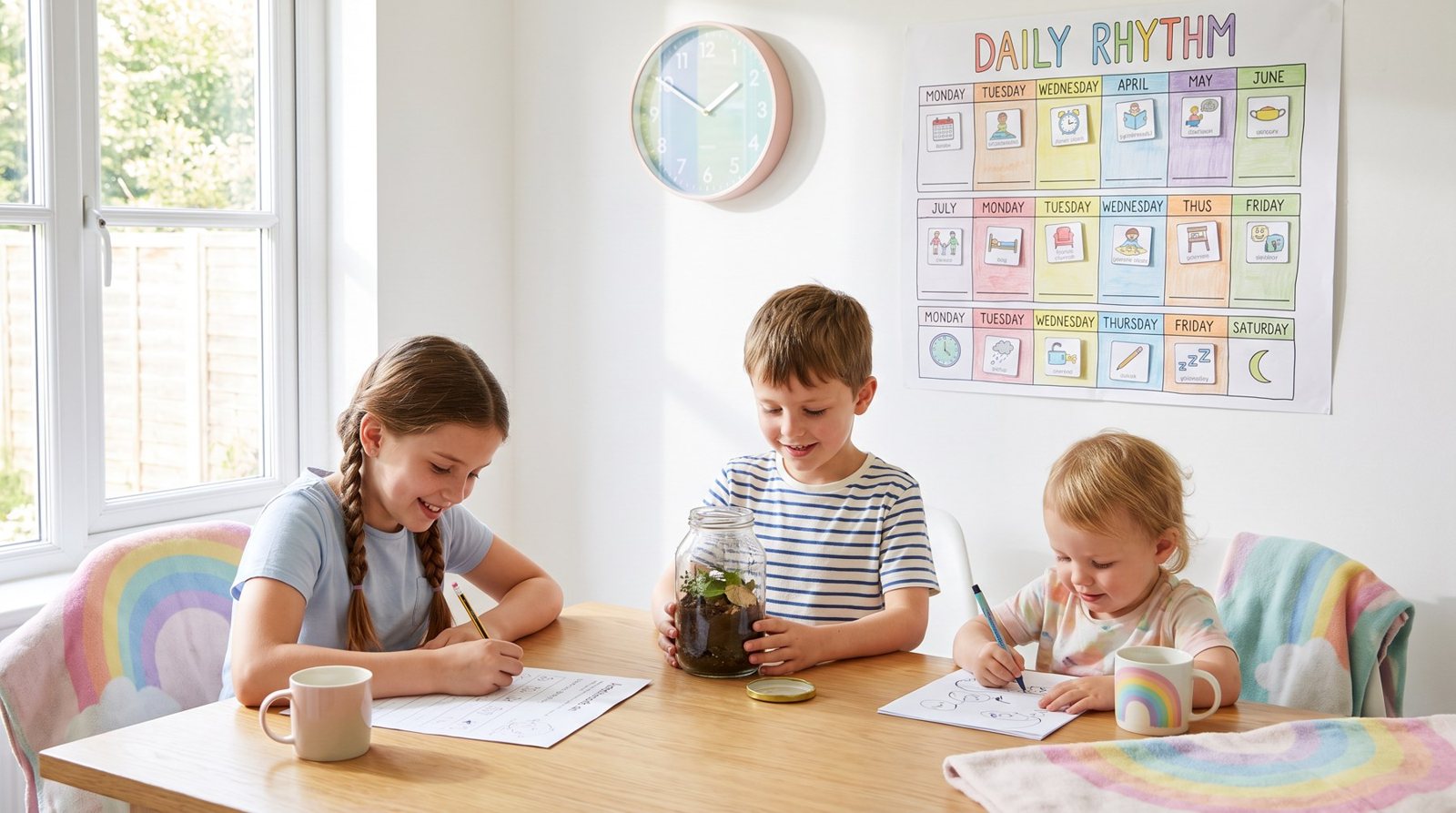
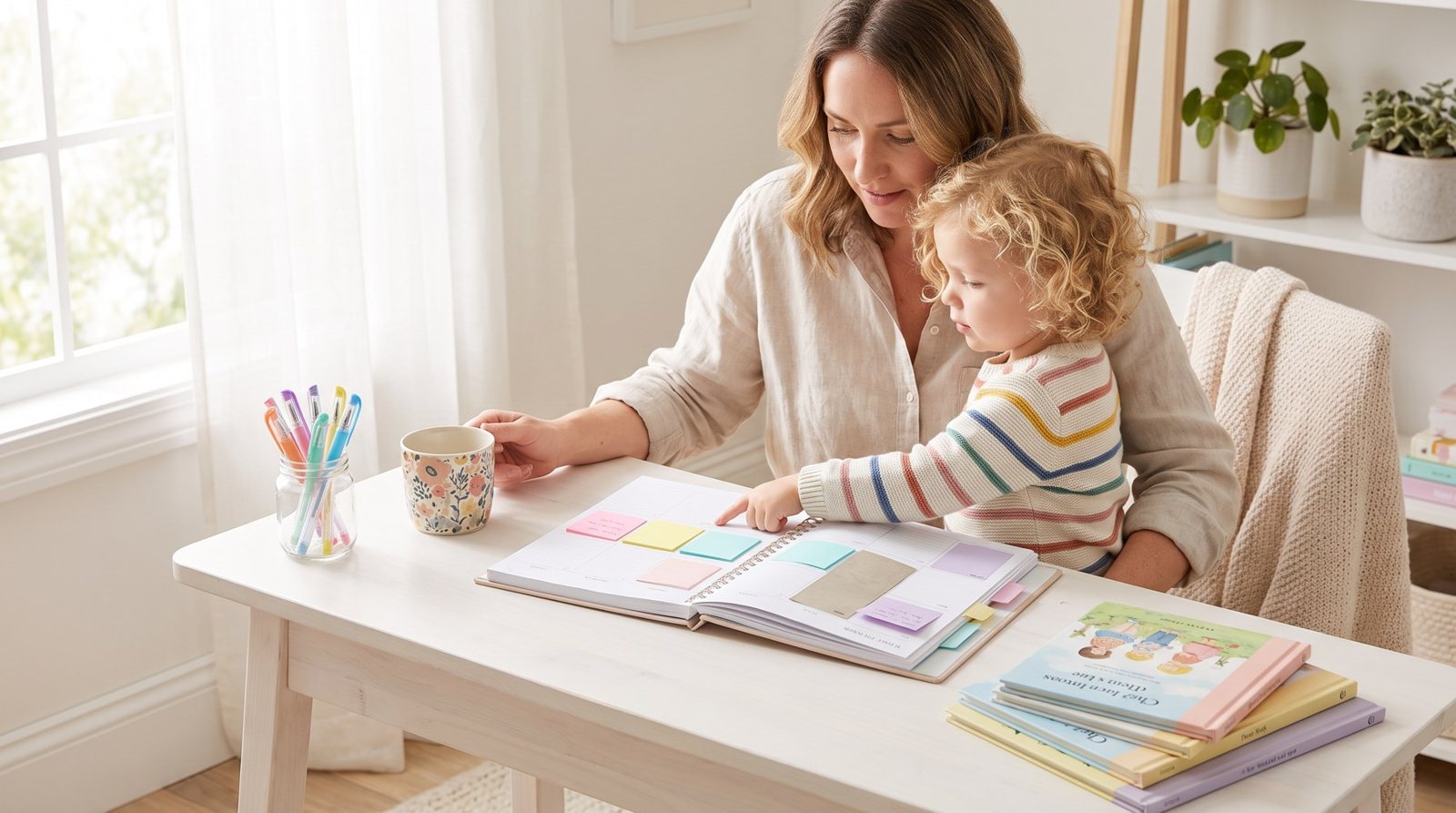
If you have ever sat at the kitchen table at 10 p.m. with three curriculum catalogs, a blank planner and a growing sense of panic, you are in good company. Homeschool lesson planning is the part that keeps a lot of new homeschool moms up at night.
Here is the good news: it does not have to be complicated. You do not need color-coded spreadsheets for every hour of the school year. You need a loose plan for the year, a light plan for each term and a clear, simple plan for the week ahead.
This guide walks you through how to plan homeschool lessons step by step, for kids from kindergarten through eighth grade, including families teaching more than one age at once. Step right up, and let's make planning feel like the fun part again.
Quick answer: The simplest way to approach homeschool lesson planning is to work in three layers. Sketch a loose yearly outline of themes and skills, choose a handful of books and projects for each term, then plan just one or two weeks at a time using a repeating weekly rhythm. Teach one shared book or theme to all ages and adjust the depth for each child. Keep math and early reading on their own track.
What homeschool lesson planning really means
When people hear "lesson plans," they often picture a teacher's binder with objectives, standards and timed activities. That level of detail makes sense in a classroom of 25 kids. At home, with your own children, it is usually overkill.
Homeschool planning is really about answering three questions:
- What are we learning? (A topic, a book, a skill.)
- How will we explore it? (Read, talk, make, move, write.)
- What do I need ready? (Books from the library, supplies, a printable.)
That is it. If your plan answers those three questions for each day, you have a lesson plan. Everything else is optional decoration.
Gigi, our Ringmaster, grew up in her mom's classroom, curled up in the reading corner with a stack of library books. What she remembers most is not the worksheets. It is the stories and the big questions that came out of them. That is the spirit we want your plans to protect.
Before you plan: three decisions that make everything easier
A little thinking up front saves you hours later. Before you open a planner, make these three decisions.
1. Check what your state requires
Homeschool laws vary by state. Some states ask for a notice of intent, some want a portfolio or test scores, and some ask for very little. Look up your state on HSLDA's state law page or your state department of education so you know which records to keep. This is not legal advice, just a reminder to know your local rules before you build your system around them.
If you are brand new, our guide on how to start homeschooling covers the first steps in more detail.
2. Decide your planning style
Most homeschool families land somewhere on a spectrum:
- Boxed curriculum: Lessons are pre-planned for you. Great for confidence, but it can feel rigid.
- Literature-based or unit study: Learning is built around books and themes. Flexible and joyful, but it needs a simple structure so nothing slips.
- Interest-led: Kids follow curiosity, and you document what happens. Freeing, but harder to plan ahead.
Many families blend these. A common, very workable mix is a dedicated math program and phonics or reading program, plus everything else (science, history, art, writing) woven around great books.
3. Pick a weekly rhythm you can repeat
This is the single biggest time-saver of all. When every week follows the same shape, planning becomes fill-in-the-blanks instead of starting from scratch.
The three layers of homeschool lesson planning
Think of your plan like a circus tent: a big frame that holds steady, a few strong poles, and plenty of room inside for the show to change night to night.
Layer one: the yearly outline (one page)
Your year plan should fit on a single sheet of paper. Jot down:
- The core skills each child is working on (for example, "reading CVC words," "multiplying two-digit numbers," "writing a five-paragraph essay").
- Four seasonal themes or big topics you would love to explore.
- Any fixed dates: holidays, family trips, co-op days, a new baby, a move.
Do not plan individual lessons yet. You are only drawing the outline of the tent.
Layer two: the term plan (six to twelve weeks)
For each term or season, choose:
- A theme (Snow and Ice, Ocean Life, Ancient Egypt, Insects).
- Four to eight anchor books that fit the theme.
- One bigger project or field trip to work toward.
Seasonal themes work beautifully because the world outside does half the teaching. In winter, you can read The Snowy Day by Ezra Jack Keats and then go measure real snow on the porch. If you love this approach, our guide to homeschool unit studies goes deeper.
Layer three: the weekly plan (one or two weeks ahead)
This is where the detail lives. Plan one or two weeks at a time, never the whole term in daily detail. Kids get colds. A chapter takes three days instead of one. A child suddenly wants to know everything about owls. Short planning horizons let you say yes to those moments.
Our signature five-day rhythm
Here is the weekly rhythm we use across everything we make at Quaintly Curious. It turns one picture book or theme into a full, balanced week, and it works for every age.
| Day | Name | What happens | Example (book: Owl Moon by Jane Yolen) |
|---|---|---|---|
| Monday | Read & Wonder | Read the anchor book aloud, notice details, list questions | Read Owl Moon, list "I wonder" questions about owls |
| Tuesday | Words & Worlds | Vocabulary, writing, geography and history connections | Collect "quiet" words, map where great horned owls live |
| Wednesday | Nature & Number | Science and math tied to the theme | Owl facts, measure wingspans with string, a night sky walk |
| Thursday | Make & Do | Art, building, crafts, cooking, drama | Make paper owl puppets and act out the walk |
| Friday | Showtime | Kids share or present what they made | Puppet show for a grandparent on a video call |
Why does this work so well?
- It is balanced. Literacy, science, math, art and speaking all get a turn without you tracking twelve separate subjects.
- It is predictable. Kids know what each day feels like, which cuts down on resistance.
- It is fast to plan. You choose a book, then fill in five boxes.
- It ends with a celebration. Friday Showtime gives kids a reason to finish and a moment to feel proud.
Math and early reading lessons sit alongside this rhythm, usually 15 to 45 minutes a day depending on age, using whatever program fits your child.
If you would like this rhythm already laid out for you, The Popcorn Planner is our free printable that "pops" any picture book into a bite-sized, five-day week for Littles, Middles and Bigs. It even includes a fully worked week for Blueberries for Sal by Robert McCloskey, so you can see exactly how it fits together.
How to plan homeschool lessons in one hour a week
Here is a simple Sunday routine. Set a timer, pour something warm and follow these steps.
- Look back (5 minutes). Skim last week's notes. What did the kids love? What needs another go? What can you drop?
- Choose your anchor (10 minutes). Pick this week's picture book or topic from your term list. Place a library hold if you need to.
- Fill in the five days (20 minutes). Write one main activity per day using the rhythm above. Keep each to a single line.
- Add age layers (10 minutes). Under each activity, add a quick note for each child or level (more on this below).
- Slot in math and reading (5 minutes). Note the next lesson numbers in each child's program.
- Make a supply list (5 minutes). Paper plates, string, flour, a library trip? Write it down now.
- Prep one thing (5 minutes). Print a page, pull a book off the shelf or set out the craft box. Future you will be grateful.
That is about an hour. After a few weeks, many parents find it takes even less, because the rhythm does the heavy lifting.
Planning for multiple ages
Teaching a kindergartner and a seventh grader at the same table can feel like running three rings at once. The trick is to share the story and split the depth.
Share the anchor, layer the work
Everyone hears the same book. Then each child responds at their own level. Here is an example using Snowflake Bentley by Jacqueline Briggs Martin:
| Level | Daily time (approx.) | Response to Snowflake Bentley |
|---|---|---|
| Littles (K-3) | 30-45 min | Fold and cut paper snowflakes, count the six points, draw a favorite page |
| Middles (4-6) | 60-90 min | Write a paragraph about Bentley's persistence, look at ice crystals with a magnifier |
| Bigs (7-8) | 90-120 min | Research how snow crystals form, write a short biography, compare photos with sketches |
Keep skill subjects separate
Math, phonics and handwriting build step by step, so each child works at their own level. Everything else (literature, science, history, art) can happily be shared.
Plan for the little ones, too
A toddler or preschooler at the table needs a plan as much as anyone. A busy bag, playdough tied to the theme or a basket of board books goes a long way. Our full guide on homeschooling multiple ages has many more ideas.
Building a homeschool schedule around your plan
Your lesson plan says what you will learn. Your schedule says when. They work best together, but they are not the same thing.
Some families like a clock-based day ("math at 9:00"). Many prefer a gentle routine ("after breakfast we do the morning basket, then math, then our rhythm activity"). Routines bend more easily around naps, appointments and grumpy mornings.
For sample daily and weekly schedules for Littles, Middles and Bigs, see our guide to building a homeschool schedule that actually fits your family.
Starting the day with a morning basket
A morning basket is a simple collection of books and activities you share together at the start of the day: poetry, a read-aloud, a picture study, a song, a calendar check. It is one of the easiest ways to bring everyone together before splitting off for individual work.
It also makes planning easier. Instead of fitting poetry, art appreciation and music into separate lessons, you rotate them through a cozy 15 to 30 minutes each morning. Learn how to set one up in our guide to the homeschool morning basket.
Choosing books for your lesson plans
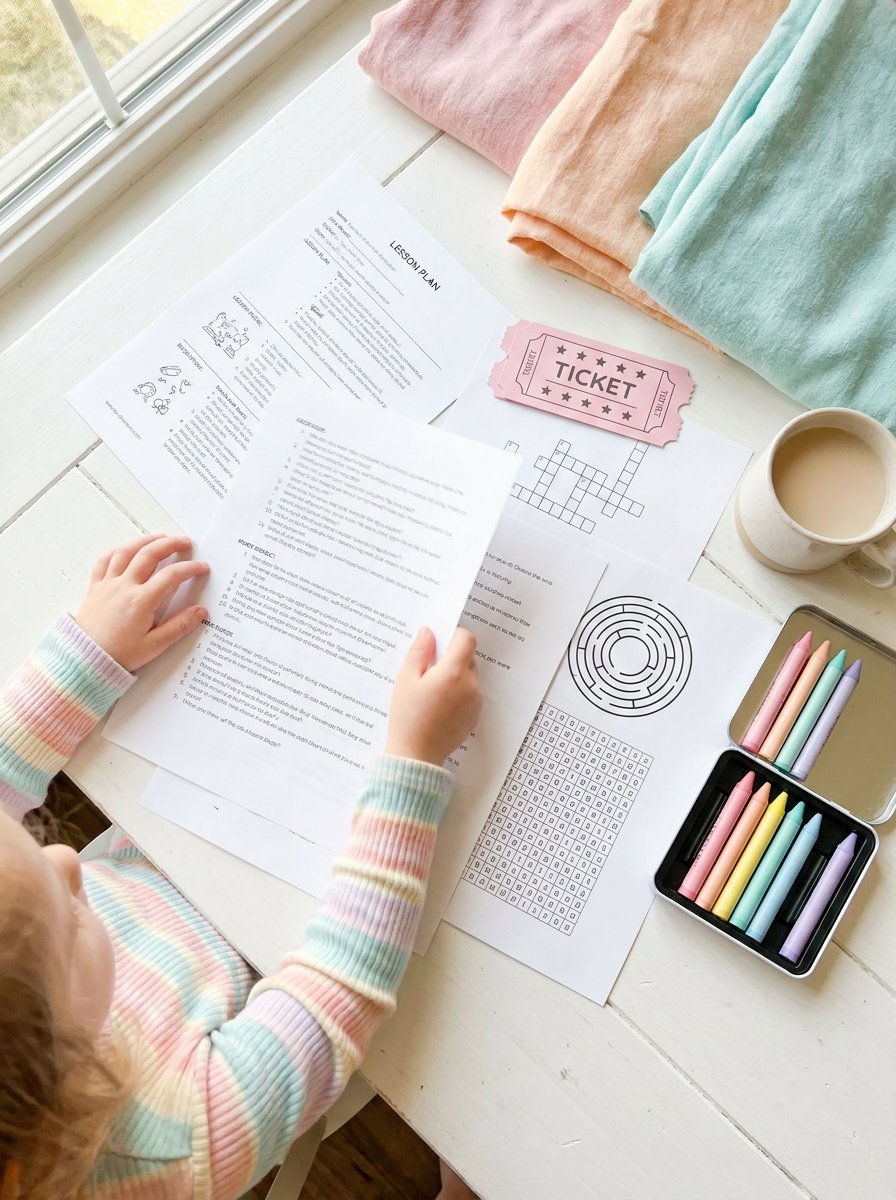
Great picture books are the secret engine of a joyful homeschool week. They work for all ages (yes, even middle schoolers), they are short enough to reread, and they spark questions that lead naturally into science, history and art.
A few dependable favorites that plan beautifully:
- Blueberries for Sal by Robert McCloskey (bears, seasons, counting)
- The Very Hungry Caterpillar by Eric Carle (life cycles, days of the week)
- Make Way for Ducklings by Robert McCloskey (maps, city life, birds)
- The Mitten by Jan Brett (retelling, animals in winter, sequencing)
- Owl Moon by Jane Yolen (nature, quiet observation, descriptive writing)
- Miss Rumphius by Barbara Cooney (life choices, plants, kindness)
For award-winning ideas, the Association for Library Service to Children keeps lists of Caldecott Medal winners, and your local children's librarian is one of your best planning allies.
Want to see how one book becomes a whole week? Our guide to picture book lesson plans shows the process step by step.
Common homeschool planning mistakes (and easy fixes)
Every homeschool parent stumbles a little in the first year. Here are the most common snags.
Overplanning
Planning six months of daily lessons in August feels productive. By October, you are rewriting everything. Fix: Plan in detail only one or two weeks ahead.
Scheduling every minute
A packed timetable leaves no room for a child's sudden fascination with volcanoes. Fix: Plan one main activity per day and leave white space.
Treating the plan like a contract
If you only got through three days this week, you did not fail. You found the right pace. Fix: Move unfinished work forward and keep going.
Planning separate everything for every child
Three kids times six subjects is eighteen plans a day. That is a recipe for burnout. Fix: Share one anchor book and theme, and separate only math and reading.
Forgetting to look back
Your notes from last week are your best planning tool. Fix: Jot a quick "loved it, skip it, repeat it" note at the end of each day.
Keeping simple records as you go
Planning and record keeping can be the same habit. At the end of each day, take two minutes to note what actually happened. Check off what you did, add a photo of the craft or a sentence about the best question someone asked.
Over a year, those quick notes become a lovely portfolio. They are also handy if your state asks for records, and they make it much easier to see real progress on the days you wonder if anyone is learning anything at all. (They are. Truly.)
Frequently asked questions
How far ahead should I plan homeschool lessons?
Most families do best with a loose yearly outline, a lighter plan for each six to twelve week term, and a detailed plan only one or two weeks ahead. Planning daily lessons months in advance usually backfires, because kids get sick, interests change and some topics take longer than expected. Short planning horizons keep you flexible and save hours of rewriting.
How long does homeschool lesson planning take each week?
Once you have a repeating weekly rhythm, many parents plan a full week in about an hour, often on a Sunday afternoon. The first few weeks take longer while you set up your system. Using a shared book or theme for all your kids, plus a planner template, cuts the time down because you are filling in blanks instead of starting over.
Do I need to write formal lesson plans to homeschool?
Usually not. Most families keep simple notes: the book, the activity and the materials for each day. Some states ask for records such as attendance, a portfolio or test results, so check your state's rules on HSLDA's state law page or your state department of education. A short daily log often doubles as your record keeping.
How do I plan homeschool lessons for multiple ages?
Start with one shared anchor, such as a picture book or theme, and teach it to everyone together. Then layer the work by age: Littles draw and narrate, Middles write a paragraph or run a simple experiment, Bigs research and write longer pieces. Keep math and early reading separate, since those skills build step by step for each child.
What should a homeschool lesson plan include?
A useful plan includes the goal or big question, the book or resource, a short activity, the materials you need and a quick note on how it went. For multiple kids, add one line per level. Keep it brief enough to read in a minute in the morning. The best plan is the one you will actually open.
The show must go on (gently)
Homeschool lesson planning is not about perfection. It is about giving your days a shape so you can relax inside them. Sketch the year loosely, choose a few great books for the term, and plan one week at a time with a rhythm you can repeat. Share stories across ages, keep skill work separate and leave room for wonder.
Some weeks will run like a well-rehearsed show. Others will be a bit of a circus. Both count.
Step right up: Want the planning done for you? The Big Top is our seasonal homeschool membership: four weeks of ready-to-go lesson plans per monthly Act, separate PDFs for Littles, Middles and Bigs, weekly puzzles, games and Friday Showtime with the Troupe, all for one flat $33 a month for the whole family. Season 1, The Frost Fair, opens November 27, 2026. Not ready yet? Grab The Popcorn Planner free and plan your first picture book week tonight.