When the first snow falls, kids want to be in it, on it and catching it on their tongues. A winter unit study turns that excitement into a week of real science, beautiful books and hands-on making that the whole family can share.
This plan works for kindergartners through eighth graders. Everyone explores the same big question (how does snow actually work?), and each child goes as deep as they are ready to go. No snow where you live? You can still do almost all of it.
Quick answer: Plan your winter week around (1) how snowflakes form, (2) why every snowflake has six sides, (3) how water freezes and expands, (4) how animals survive the cold, and (5) the story of Wilson "Snowflake" Bentley. Spread these over a five-day rhythm with picture books, simple experiments, a craft and a Friday share.
If you are new to themed learning, start with our big-picture guide to homeschool unit studies. Then come back here and let the snow show begin.
The snowflake science your kids will love
Before you plan activities, it helps to know the real science. Here is the kid-friendly version.
How snowflakes form
Snowflakes begin high in cold clouds. A tiny speck of dust or pollen gives water a place to freeze, making a very small ice crystal. Then water vapor (water in gas form) freezes directly onto that crystal without becoming liquid first. Layer by layer, the crystal grows heavy enough to fall.
Why snowflakes have six sides
When water freezes, its molecules lock together in a hexagonal (six-sided) pattern. As the crystal grows, that pattern repeats, so the arms and corners grow out in six directions. That is why snowflakes are six-pointed stars or six-sided plates, never five or eight.
Why no two look quite the same
The exact shape depends on the temperature and humidity the crystal passes through as it falls. Slightly different conditions produce flat plates, long needles, hollow columns or lacy, branching stars. Because each crystal takes its own path, scientists consider it extremely unlikely that two complex snowflakes are exactly alike.
Why snow looks white
Each ice crystal is actually clear. But snow is made of countless tiny crystals with many surfaces, and light bounces and scatters off all of them. That scattered light reaches our eyes as white.
For gorgeous close-up photos and more detail, physicist Kenneth Libbrecht's SnowCrystals.com is a wonderful resource to explore with older kids.
Meet Wilson "Snowflake" Bentley
Wilson A. Bentley grew up on a farm in Jericho, Vermont. As a teenager he was fascinated by snow and tried to draw snowflakes under a microscope, but they melted too fast. So he paired a microscope with a bellows camera, and on January 15, 1885, he became the first person known to photograph a single snow crystal.
Over his lifetime he photographed more than 5,000 snowflakes. Many of his photographs were published in the 1931 book Snow Crystals. You can see his work and learn more from the Jericho Historical Society's Snowflake Bentley site.
His story is told beautifully in Snowflake Bentley by Jacqueline Briggs Martin, illustrated by Mary Azarian, which won the Caldecott Medal. It is the perfect anchor book for your week.
Your winter book basket
Gather these from your library before Monday:
- The Snowy Day by Ezra Jack Keats (Littles' favorite for first-snow wonder)
- Snowflake Bentley by Jacqueline Briggs Martin (anchor book for all ages)
- Owl Moon by Jane Yolen (quiet winter nights and owling)
- The Mitten by Jan Brett (retelling and sequencing)
- Over and Under the Snow by Kate Messner (animals living under the snow)
- The Story of Snow by Mark Cassino with Jon Nelson (real snowflake photographs and science)
Looking for more titles? Our list of winter picture books for kids has 15 favorites, each with an activity.
A five-day winter unit study plan
Here is the week, built on our signature rhythm. Each day has one main activity, plus a simpler version for Littles (K-3) and a stretch for Bigs (7-8). Middles (4-6) do the main activity.
| Day | Focus | Main activity | Littles (K-3) | Bigs (7-8) |
|---|---|---|---|---|
| Monday | Read & Wonder | Read Snowflake Bentley, start a snow wonder list | Draw a snowflake from the book | Note three things Bentley did like a scientist |
| Tuesday | Words & Worlds | Learn winter words: crystal, hexagon, vapor, freeze, insulate | Match words to pictures | Write a short biography paragraph on Bentley |
| Wednesday | Nature & Number | Catch and observe snowflakes, or make frost in a can | Count the arms on each snowflake | Record temperature and crystal shapes, compare to a chart |
| Thursday | Make & Do | Freezing experiment and six-fold paper snowflakes | Fold and cut a paper snowflake | Test which freezes faster: salt water or fresh water |
| Friday | Showtime | Share a snowflake museum and findings | Show and tell a favorite snowflake | Present experiment results with a simple graph |
Want a winter word search or maze to slip into Tuesday? Our free Frost Fair Puzzle Sampler has winter puzzle pages for every level.
Hands-on winter science experiments
These are easy, cheap and reliable. Supervise anything involving the freezer or salt.
Catch and study real snowflakes
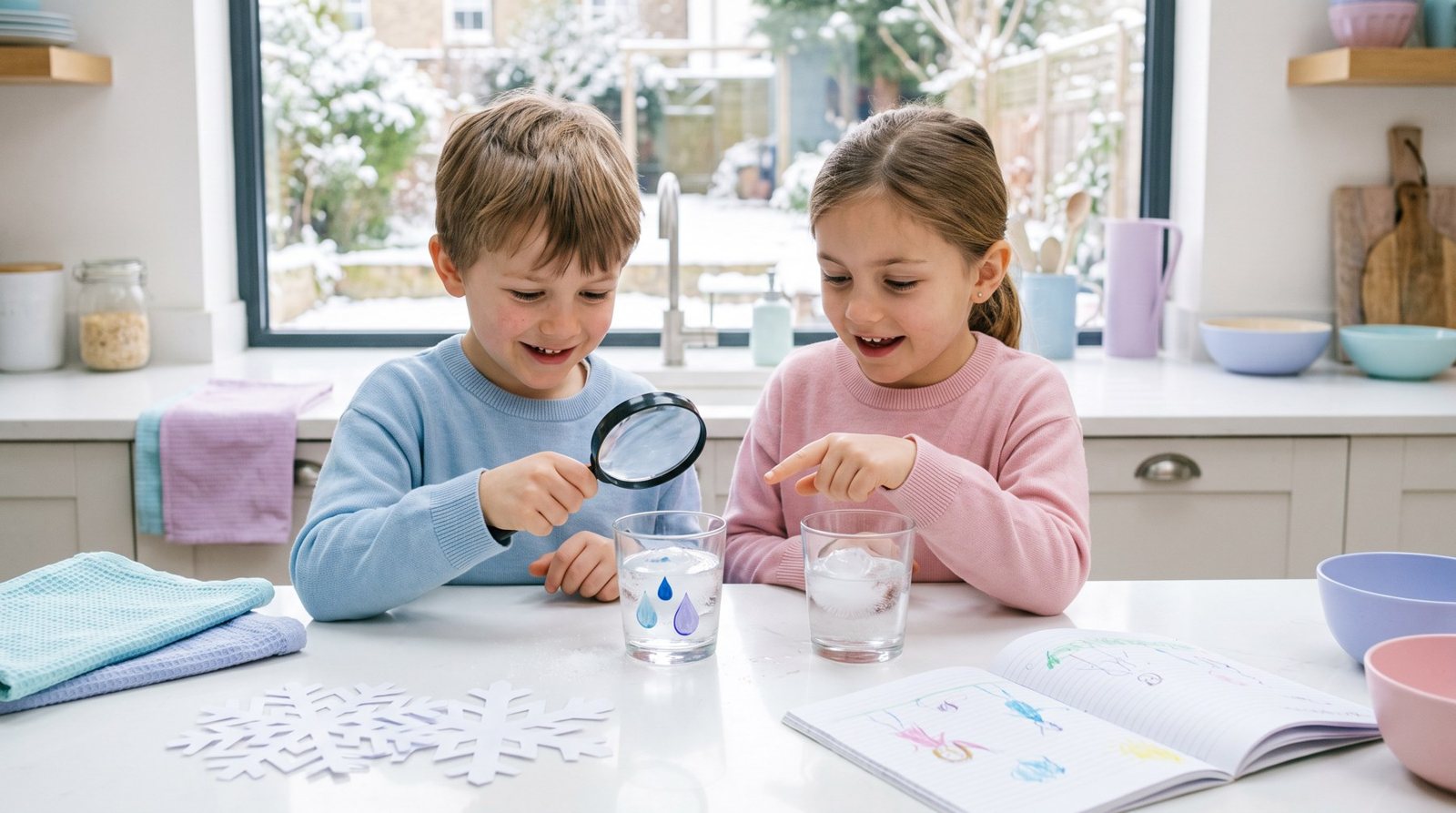
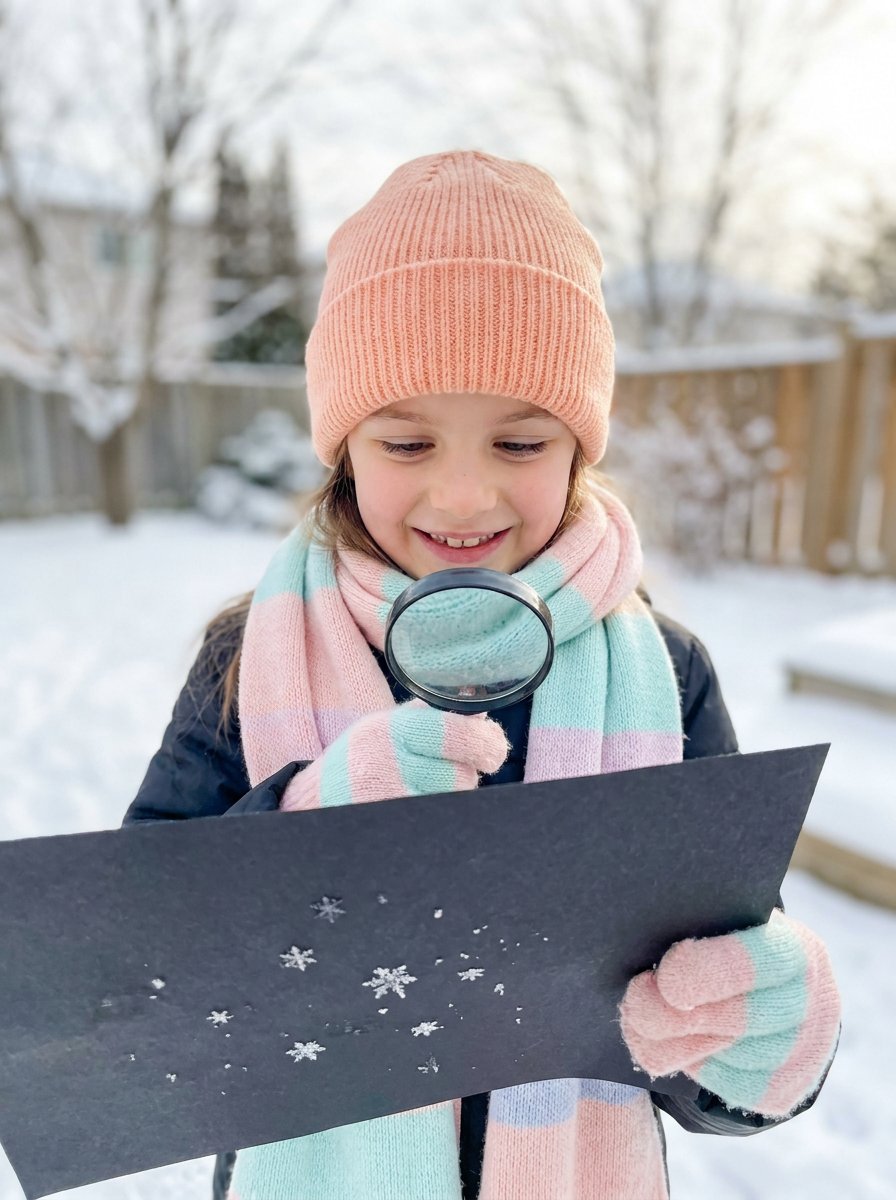
Chill a piece of black paper or dark fabric outside for a few minutes. Hold it out as snow falls, then look closely with a magnifying glass. Count the arms. Sketch the shapes. Colder, drier days often give the crispest crystals.
Make frost in a can (no snow needed)
Fill a clean metal can with crushed ice and stir in a few spoonfuls of salt. In a few minutes, frost forms on the outside. The salt makes the ice mixture colder than freezing, and water vapor from the air turns straight to ice on the cold metal. That is the same "vapor to ice" step that grows snowflakes.
Why does ice float?
Fill a small plastic container to the brim with water, mark the line, and freeze it. Water expands as it freezes, so the ice rises above the line. Then drop an ice cube in a glass of water. It floats because ice is less dense than liquid water. Bigs can connect this to why lakes freeze from the top down, leaving water beneath for fish.
Snow as a blanket
Put one thermometer on top of the snow and push another a few inches into a snowbank. Compare the readings. Snow traps air, which slows heat loss, so it acts like insulation. Over and Under the Snow shows how small animals use this to survive winter.

Winter homeschool activities beyond science
- Writing: Littles narrate "My Snowy Day." Middles write a winter senses poem. Bigs write a short persuasive piece: "Should snow days count as learning days?"
- Math: Graph daily temperatures for a week. Explore symmetry by folding paper snowflakes. Measure snow depth in three spots and find the average.
- Geography: Find the coldest places on Earth on a globe and talk about where it snows and where it never does.
- Art: Watercolor resist snowflakes (draw in white crayon, paint over in blue).
- Movement: Act out The Mitten, with each child playing a different animal squeezing in.
For tips on fitting these into your days, see our sample homeschool schedules by age. And if your kids love brain teasers, our guide to educational puzzles for kids shows how to use puzzles for review.
Frequently asked questions
What should a winter unit study include?
A good winter week mixes picture books, real science and hands-on making. Try snowflake formation, ice and freezing experiments, animals in winter and the story of Wilson Bentley. Add vocabulary, a little writing, some measuring or graphing, a craft, and a Friday share so your kids can show what they learned.
How do snowflakes form?
Snowflakes form high in cold clouds. Water vapor freezes onto a tiny particle, such as dust or pollen, to make a small ice crystal. More vapor then freezes directly onto that crystal, and it grows into a six-sided shape. The temperature and moisture in the air shape whether it becomes a flat plate, a column, a needle or a branching star.
Why do all snowflakes have six sides?
Snowflakes have six sides because of the way water molecules link together when they freeze. They lock into a hexagonal, or six-sided, pattern. As a crystal grows, that pattern repeats, so the corners and arms of the snowflake grow out in six directions. That is why you see six-pointed stars and six-sided plates.
Can you do a winter unit study without snow?
Absolutely. You can make frost in a can with ice and salt, freeze water to watch it expand, grow salt or sugar crystals, cut paper snowflakes with six-fold symmetry, and look at snowflake photographs online. Picture books and nonfiction bring the snowy world to you, wherever you live.
Who was Snowflake Bentley?
Wilson A. Bentley was a farmer from Jericho, Vermont, who became the first person known to photograph a single snowflake, in 1885. He attached a camera to a microscope and spent decades capturing more than 5,000 snow crystals. His story is told in the Caldecott Medal picture book Snowflake Bentley by Jacqueline Briggs Martin.
Let it snow (and let them wonder)
Winter learning does not need to be elaborate. One great book, one big question and a few chilly experiments can fill a week with wonder. Catch a snowflake, count its arms, and let your kids be scientists just like Wilson Bentley.
Step right up: Want a whole winter of this, planned and printable? The Big Top opens Season 1, "The Frost Fair," on November 27, 2026, with Act I Snow & Ice, Act II Poles Apart and Act III Night Sky. Each Act brings four weeks of five-day lessons for Littles, Middles and Bigs, weekly puzzles, games, a month-end project and Friday Showtime with the Troupe, all for $33/month for the whole family, cancel anytime. Prefer a single cozy week? Winter Wonders is a $9 printable mini unit built on The Snowy Day, Owl Moon, The Mitten and Snowflake Bentley, with 36 puzzles.